Note to the Reader:
If you’ve been following my Deconstruction Series, you may remember that I briefly mentioned my first Holy Communion classes. As my home parish celebrates its Jubilee year, the emotions tied to spending my childhood, teenage years, and youth within its walls have felt more vivid than usual. Revisiting those memories encouraged me to expand on what I had only touched on before.
Originally published in the 75th anniversary souvenir of the Secunderabad–Hyderabad Mar Thoma Parish (2026). Shared here in its original form.
Seasons When Faith Became My Own
When someone asks me, ‘Hey, when did you first accept Jesus?’ I often think it must have been between the ages of 12 and 14, during my First Holy Communion classes, which were truly one of my fondest memories of growing up in the Secunderabad-Hyderabad Mar Thoma parish. Those lessons were more than just preparation for a sacrament, and I believe S Achen was exceptionally good at leading the sessions. Those classes, along with my interactions with him, played a significant role in shaping my faith during those formative years.
When I think back to those classes, the memories come wrapped in joy. I remember being really excited on Sundays when we had the classes post service. Achen had a way of making every lesson feel like a conversation rather than a classroom. I was a child bubbling with questions: endless, eager, sometimes oddly specific. And he loved every one of them. He welcomed my curiosity instead of brushing it aside. Because of him, faith felt less something that was expected of me and more like something I was allowed to understand, explore and question.
The next vicar, B Achen, also shaped another facet of my faith. By then, I was already a little older and able to engage with my faith with more thirst. I remember once telling him, with the straightforward honesty only a teenager can manage, that when he preached in Malayalam it would help us kids if he at least mentioned the Bible passages in English. It was such a small request, the kind adults often overlook, but he didn’t. He took it seriously and responded with kindness. I remember almost every Sunday after that, I made it a point to meet him and tell him how the sermon spoke to me. He played such an affectionate and fatherly role in my life during those years. Only years later did I realise how significant that sensitivity was and that speaks volumes about how gentle a shepherd he was in his leadership and administration.
Another memory resurfaced long after those early days. When I re-met S Achen about three years ago for a youth camp, the first thing he asked me was, “Mole, do you still have the habit of writing sermon notes?” His question almost made me teary-eyed and brought back another thread of memories I had forgotten: how, during his visits to our house, I used to bring him my notebook and ask about the parts of the sermon I didn’t understand. At that age, I didn’t realise how much it meant to him that a young girl was listening, thinking and trying to make sense of her faith. That he noticed and cared is very true to the teacher and scholar he is. Only as an adult did I fully understand the weight of that moment.
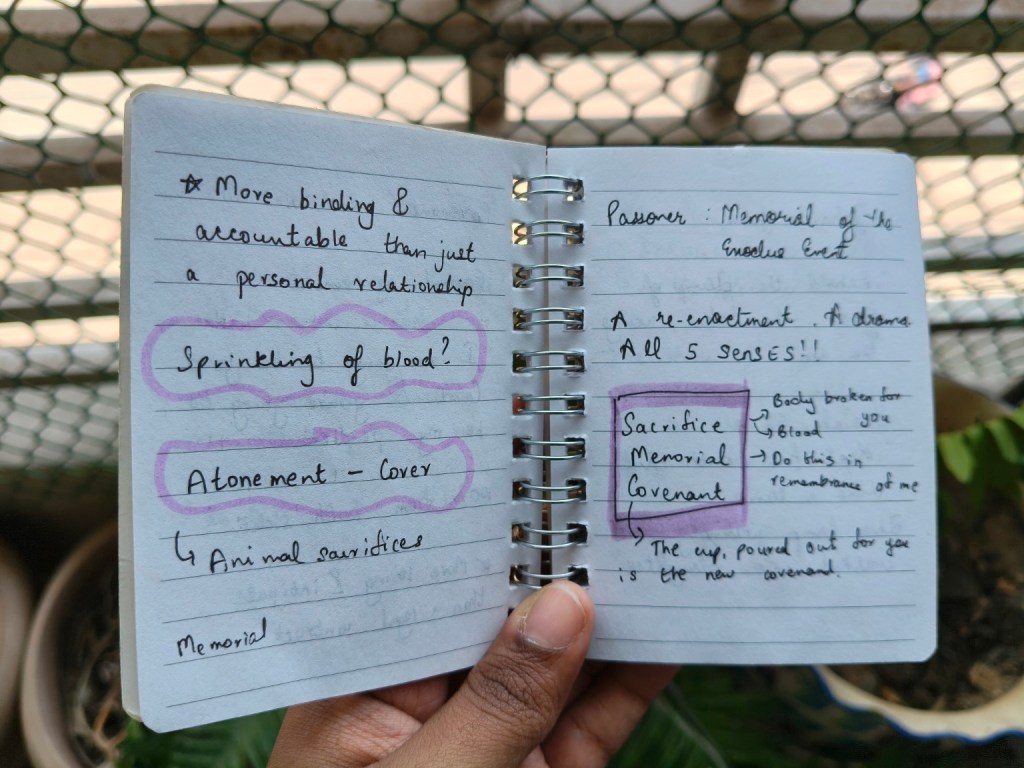
Different location. Different church. Yet the same thread remains: Passover, covenant, communion.
Very coincidentally, this year in 2025, I once again had the privilege of meeting both of them for different occasions. Seeing them again rekindled every warm memory of the two achens who shaped my early spiritual life. What made these memories remarkable was experiencing this during my formative years, during my tweens (9-12) and teens (13-17), added so much more value before I stepped into adulthood.
I consider it a privilege that I was guided by vicars who did not simply teach me doctrines but welcomed my mind, my questions, and my voice. I am grateful for people who took my questions seriously, made time for my curiosity, and showed me that the church can be a place where the heart and mind grow together. These moments remind me that the Jubilee isn’t just about years on a calendar, but about the generations of hearts it has nurtured. They remind me that a church is built not only by its milestones but by the patient, thoughtful, tender moments that shape its people.
Because of these moments, I can gladly say that my faith isn’t just inherited. It has become my own.
What a joy to proclaim! What a privilege to hold!
Post-reading notes
1. On appreciation and accountability
I have always believed that pastoral appreciation is necessary, just as believers are called to encourage one another. While we continue to call out power imbalances, strive for accountability, and seek justice within our church spaces, it is equally important to recognise and value those who steward their platforms and pulpits with the right burden on their hearts.
To read another reflection related to my home parish, you can click here.
2. On privacy
I have chosen not to include their full names here for privacy. Those from the same parish will likely know who I am referring to, and perhaps share in the gratitude I feel for their guidance.
3. On the larger journey
Although my deconstruction journey took place much later, during my college years, I still believe these early experiences played a pivotal role in shaping my faith.
If you are new here and haven’t yet read the Deconstruction Series, you can click here.
4. On being cross-denominational
I have always wanted this blog to remain cross-denominational, reflecting the way my faith has been shaped across different spaces. Yet I remain deeply grateful for the church that raised me and nurtured the earliest roots of that journey
Thank you for reading! I truly appreciate this! 🙂


Leave a Reply