As India goes through a historic moment of dissent, dialogue and peaceful protest, I am reminded of five women in the book of Numbers who stood before authority and changed the law.
Numbers 27 tells the story of a man who dies without a male heir. According to the law, his family line would lose its inheritance. His daughters (Mahlah, Noah, Hoglah, Milkah and Tirzah) approached Moses, the priests, the leaders and the whole assembly to present their case. Moses brought the matter before the Lord, and the law was amended to allow daughters to inherit in the absence of a son.
Numbers 27: 5-7
So Moses brought their case before the Lord and the Lord said to him, “What Zelophehad’s daughters are saying is right. You must certainly give them property as in inheritance among their father’s relatives and give their father’s inheritance to them. “Say to the Israelites, ‘If a man dies and leaves no son, give his inheritance to his daughter.
When I first read it I was wondering, “How is this improvement?” This is only a clause. Daughters could only inherit if there was no son. Shouldn’t inheritance belong equally to all children regardless of gender?
But then I caught myself.
I was expecting a society four thousand years ago to arrive instantly at the standards I have inherited after centuries of legal, social and moral development.
These five women were not standing in a courtroom in twenty-first century India. They were standing before Moses in the wilderness. What looked like an incomplete victory to me may have been a revolutionary step in their world.
That made me think about our own moment as a country yesterday.
Many people have responded to the resignation of the Education Minister by saying, “This changes nothing.” Others point out that dozens of deeper issues remain unresolved. They may be right. One resignation does not fix an entire system.
But Numbers 27 reminds me that history often moves by amendments before it moves by revolutions.
The daughters of Zelophehad did not receive everything they could have asked for. But because they spoke, the law became more just than it had been before.
Their courage changed the conversation, and eventually changed the law itself.
What strikes me just as much is the character of God in this story. These women were not rebuked for questioning the law or dismissed because they were women. Their petition was heard. Moses took their case before the Lord, and God declared, “What Zelophehad’s daughters are saying is right.”
I am reminded of a God who is not threatened by honest questions or faithful appeals for justice. A God who invites people into conversation, who listens, and who calls what is right, right. As a woman, there is something deeply reassuring about seeing women in Scripture speak with courage before both human and divine authority and be met, not with condemnation, but with affirmation.
Coming back to my country I am reminded of the same truth in a different context.
I am reminded of the people who refused to stop speaking.
I am reminded of the power of ordinary people coming together to create extraordinary and larger than life ripples.
And I am reminded that dissent, when rooted in truth and hope, can become an instrument of justice.
May this day remind us that God is not threatened by faithful voices seeking justice, but delights in them.
Isaiah 1:17 Learn to do good; Seek justice, Correct Oppression
May this day remind us to be the hands and feet of the values we believe in.
A question to myself: How different might this scene appear to a praying mantis?
Introduction
I was recently reminded of the fact that a mantis shrimp might see a sunset that is far richer than the one we see, beyond the purples, oranges, and pinks familiar to human eyes.
And that thought sent me into a spiral of realisations.
What if the world is already more complex, more layered, more beautiful than we are capable of perceiving?
Let me explain.
Understanding What We See
Humans have three types of cone cells in our eyes, each sensitive to different wavelengths of light. These allow us to perceive what we call colour—millions of variations constructed from these three channels. Even something as subdued as beige or as vibrant as violet exists within the limits of what our biology allows us to see.
Now take it one step down.
Dogs and tigers, for instance, have only two types of cone cells. Dogs primarily perceive blues and yellows, while big cats like tigers see within a more limited blue-green spectrum. Their world is not colourless—but it is different, constrained in ways ours is not.
And then, there are butterflies. Many butterflies have four to six types of cone cells, and some can detect ultraviolet light. That means they perceive dimensions of colour that are completely inaccessible to us. I can simulate what a dog might see by filtering colours.
But here is where things get interesting.
While I can simulate what dog or tiger vision might look like, I will never truly understand butterfly vision. Not because I lack imagination, but because my biology does not allow me to perceive anything beyond the red, green, and blue framework.
Question to self: As I take in the greens of the leaves and the soft variations of pink in the buds and flowers, I wonder, what is the butterfly seeing, beyond what I can perceive?
This is where the idea of qualia comes in.
In Philosophy of Mind (a branch of philosophy concerned with the nature of the mind, mental states, and consciousness), qualia refers to the subjective experience of perception. It is not just about seeing a colour, but about what it feels like to see that colour. It is the difference between knowing that light has a certain wavelength and actually experiencing that wavelength as “blue” or “red”.
Scientists can describe exactly how a butterfly detects ultraviolet light. They can map the receptors, the signals, and the responses. But description is not the same as experience.
I can learn everything about how a butterfly sees the world. I can study the wavelengths it detects, the ultraviolet patterns it follows, and the way its brain processes colour.
But will I ever know what it feels like to see as a butterfly does?
As long as I am human, I am bound to human experience. My limitation is not just in knowledge, but in perception itself.
And that is what unsettled me.
If there are colours in this world that I can never perceive, then there may be aspects of reality that I am not just unaware of, but fundamentally unequipped to experience.
And that led me to think about heaven.
There is a verse in 1 Corinthians that speaks of a reality beyond what we can currently comprehend:
What about music? Will heaven have notes beyond the scales we know? What about language? Will there be words beyond anything we are able to form now?
These are things that sit just beyond the edge of my imagination.
Reflection and Wonder
As I sit back and think about this, I am reminded of the song I Can Only Imagine by MercyMe:
“Surrounded by your glory, what will my heart sing? Will I dance for you Jesus, or in awe of you be still? Will I stand in your presence, or to my knees will I fall? Will I sing hallelujah, will I be able to speak it all?”
Heaven will be many things. But I believe it will also be a place where our capacity to experience reality is made complete. Not just more knowledge, but fuller perception. Maybe then I will finally see colours I was never created to see here. Until then, I can only imagine. 🙂
Post Reading Notes (Similar Reads):
Thank you for taking the time to read the first part of my Worshipping Through Wonder Series.
If you would like to read more about reflections on heaven, you can read my blog titled Will there be Math in Heaven?
For another piece reflecting on the architecture of my home parish and how it draws me into awe-filled worship, you may enjoy Stained Glass at the Altar.
For more science (nature, evolution, biology, creation care) mingled with theology content please check out BioLogos. They are a page that continue to inspire people like me and remind me of the fact that we are created as responsible image bearers.
Image Credits:
All images used are licensed and sourced from Magnific.
If you’ve been following my Deconstruction Series, you may remember that I briefly mentioned my first Holy Communion classes. As my home parish celebrates its Jubilee year, the emotions tied to spending my childhood, teenage years, and youth within its walls have felt more vivid than usual. Revisiting those memories encouraged me to expand on what I had only touched on before.
Originally published in the 75th anniversary souvenir of the Secunderabad–Hyderabad Mar Thoma Parish (2026). Shared here in its original form.
Seasons When Faith Became My Own
When someone asks me, ‘Hey, when did you first accept Jesus?’ I often think it must have been between the ages of 12 and 14, during my First Holy Communion classes, which were truly one of my fondest memories of growing up in the Secunderabad-Hyderabad Mar Thoma parish. Those lessons were more than just preparation for a sacrament, and I believe S Achen was exceptionally good at leading the sessions. Those classes, along with my interactions with him, played a significant role in shaping my faith during those formative years.
When I think back to those classes, the memories come wrapped in joy. I remember being really excited on Sundays when we had the classes post service. Achen had a way of making every lesson feel like a conversation rather than a classroom. I was a child bubbling with questions: endless, eager, sometimes oddly specific. And he loved every one of them. He welcomed my curiosity instead of brushing it aside. Because of him, faith felt less something that was expected of me and more like something I was allowed to understand, explore and question.
The next vicar, B Achen, also shaped another facet of my faith. By then, I was already a little older and able to engage with my faith with more thirst. I remember once telling him, with the straightforward honesty only a teenager can manage, that when he preached in Malayalam it would help us kids if he at least mentioned the Bible passages in English. It was such a small request, the kind adults often overlook, but he didn’t. He took it seriously and responded with kindness. I remember almost every Sunday after that, I made it a point to meet him and tell him how the sermon spoke to me. He played such an affectionate and fatherly role in my life during those years. Only years later did I realise how significant that sensitivity was and that speaks volumes about how gentle a shepherd he was in his leadership and administration.
Another memory resurfaced long after those early days. When I re-met S Achen about three years ago for a youth camp, the first thing he asked me was, “Mole, do you still have the habit of writing sermon notes?” His question almost made me teary-eyed and brought back another thread of memories I had forgotten: how, during his visits to our house, I used to bring him my notebook and ask about the parts of the sermon I didn’t understand. At that age, I didn’t realise how much it meant to him that a young girl was listening, thinking and trying to make sense of her faith. That he noticed and cared is very true to the teacher and scholar he is. Only as an adult did I fully understand the weight of that moment.
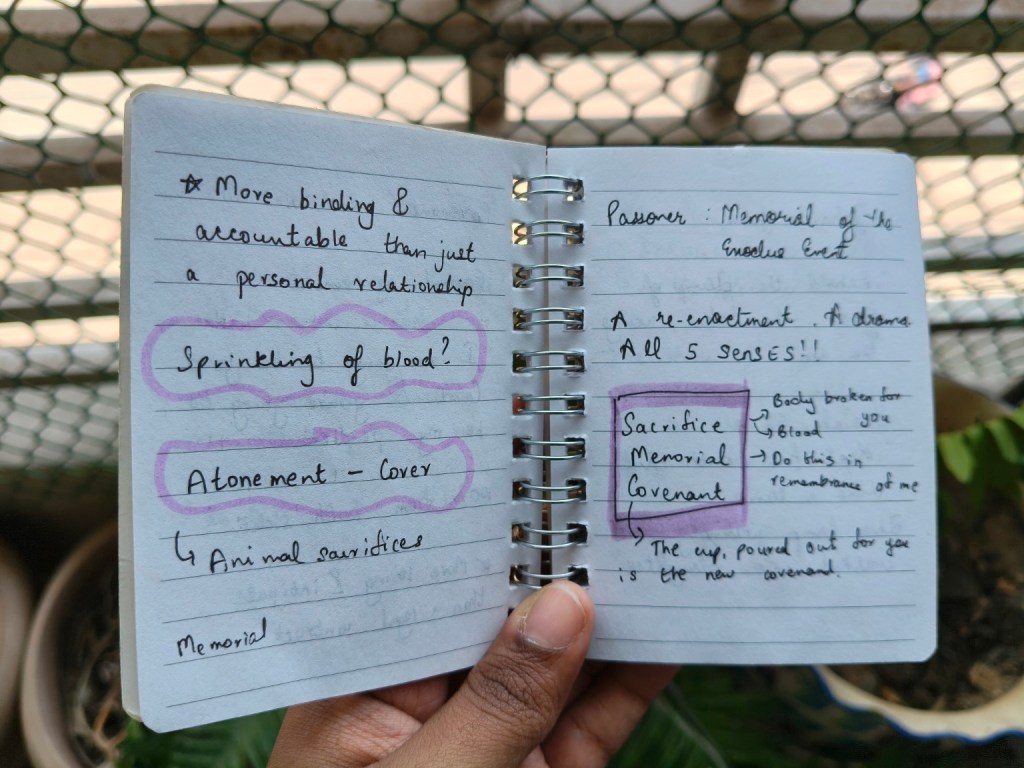
S Achen is the reason I began writing sermon notes. Here is a page of my sermon notes from 2025 (Chennai), once again on Communion. Different location. Different church. Yet the same thread remains: Passover, covenant, communion.
Very coincidentally, this year in 2025, I once again had the privilege of meeting both of them for different occasions. Seeing them again rekindled every warm memory of the two achens who shaped my early spiritual life. What made these memories remarkable was experiencing this during my formative years, during my tweens (9-12) and teens (13-17), added so much more value before I stepped into adulthood.
I consider it a privilege that I was guided by vicars who did not simply teach me doctrines but welcomed my mind, my questions, and my voice. I am grateful for people who took my questions seriously, made time for my curiosity, and showed me that the church can be a place where the heart and mind grow together. These moments remind me that the Jubilee isn’t just about years on a calendar, but about the generations of hearts it has nurtured. They remind me that a church is built not only by its milestones but by the patient, thoughtful, tender moments that shape its people.
Because of these moments, I can gladly say that my faith isn’t just inherited. It has become my own.
What a joy to proclaim! What a privilege to hold!
Post-reading notes
1. On appreciation and accountability
I have always believed that pastoral appreciation is necessary, just as believers are called to encourage one another. While we continue to call out power imbalances, strive for accountability, and seek justice within our church spaces, it is equally important to recognise and value those who steward their platforms and pulpits with the right burden on their hearts.
To read another reflection related to my home parish, you can click here.
2. On privacy
I have chosen not to include their full names here for privacy. Those from the same parish will likely know who I am referring to, and perhaps share in the gratitude I feel for their guidance.
3. On the larger journey
Although my deconstruction journey took place much later, during my college years, I still believe these early experiences played a pivotal role in shaping my faith.
If you are new here and haven’t yet read the Deconstruction Series, you can click here.
4. On being cross-denominational
I have always wanted this blog to remain cross-denominational, reflecting the way my faith has been shaped across different spaces. Yet I remain deeply grateful for the church that raised me and nurtured the earliest roots of that journey
Recently, during my quiet time, I came across the widow in 2 Kings 4:1-7. I found myself stepping into her small home and standing beside her.
Standing in Her House
A nearly empty house. A little olive oil. Two sons. And Elisha’s careful instruction echoing in her ears.
“Collect jars from your neighbours. Shut the door behind you. Pour the oil.”
I can imagine how uncomfortable that week must have been. Grieving her husband. Facing creditors. Going door to door asking for empty jars. She likely endured pitying looks because she was a widow, and confused looks because of her unusual request, all in the same week.
And still, she obeyed.
Why the Oil?
But let me rewind the story.
Why did Elisha ask her to pour from what she already had? Was it not possible for God to produce oil without the small jar in her possession? After all, He created the universe from nothing. He certainly did not need a starter batch.
So why involve her oil at all?
Yes, God could have created oil ex nihilo. But throughout Scripture, we often see Him take a route that involves people. When Jesus fed the five thousand (Mathew 14:13-21), He did not rain bread from the sky. He multiplied five loaves and two fish that a boy offered.
These miracles do not merely display power. They reveal God’s heart for partnership.
He delights in collaborating with us. Scripture reminds us that the Lord takes delight in His people (Psalms 149:4). He does not need our contribution. But He invites it. And that invitation requires total submission.
When the Jars Stopped
Lately, when I have been feeling anxious, this has been the reminder that gives me strength. Just a small jar of focus. A limited reserve of energy. A little time. But perhaps the question is not about my limitations. Perhaps the question is whether I am willing to pour it out fully.
There is one detail in the story that moves me deeply. The oil stopped only when the jars stopped. The abundance of Yahweh was not exhausted. It paused because there were no more vessels. The infinite paused only when it met the limits of the finite.
Maybe that is what we all need to do.
To give it all. With whatever little we have. To submit it wholly, in full faith.
Just like a widow with her olive oil. May we also pour out the oil we have, however little. That is my prayer.
Note to the Reader (Pre-read / Context): November is historically remembered as Reformation Month among mainline Protestant churches worldwide. While it is important to remember the early reformers, especially Martin Luther and his 95 Theses, it is equally important to turn our attention to the Reformation of the East.
Cleansing: The Heart of Reformation
When I think about the cleansing of my heart, I am often reminded of the incident recorded in the Gospels where Jesus cleansed the temple. I’ve seen so many memes of Jesus flipping tables (and honestly, they make me laugh), but I think I often forget what exactly Jesus was cleansing the temple of.
When I re-read those passages, I wondered: why was Jesus upset about people selling at the temple? After all, don’t we sometimes have stalls in our own churches today?
Here’s what I understood:
Moneychangers were profiting off worshippers under the guise of ritual purification.
Those selling animals for sacrifice were charging unfair amounts to pilgrims who had traveled far.
Jesus wasn’t angry at the convenience offered to worshippers. He was angry at the exploitation hidden behind it. What was meant to be holy had been turned into something profitable.
This is what holy anger can do: it calls us to confront injustice, upturn corrupt systems, and ensure the underprivileged aren’t being taken advantage of. Jesus set this example beautifully.
Image: Jesus cleansing the temple. Abraham Malpan’s reforms echo this posture centuries later.
I am also reminded of another moment that took place eighteen centuries later, in Kerala. Abraham Malpan, often called the “Martin Luther of the East,” sought to reform the Malankara Church and return it to the primacy of Scripture. He recognized that a wooden statue in his parish had become more important than the God it was meant to point toward. So he threw the statue into the church’s well. He was grieved by the deviation in worship.
This holy anger led to conviction: the courage to say, “If this is not what God wants, let it be removed, even if done painfully.”
These moments, separated by eighteen hundred years, remind us that holy anger is not about rage. It is about refocusing on the heart of worship—a burning desire for God’s house, God’s truth, and God’s people. Different eras, different contexts, yet the same spiritual impulse.
As we step into Advent, may we carry this spirit of Reformation forward. May we ask ourselves: “What in my heart needs to be cleansed? What tables have I allowed to remain unturned?” May we let God call us, refine us and use us, even if it means flipping tables in the spaces He’s placed us.
May we all have a Blessed Advent!
Note to the Reader (Post-read /Reflection): Abraham Malpan’s reforms eventually led to the formation of the Mar Thoma Church. Even if your own faith heritage did not come through this particular movement, his spirit and courage remains an inspiration. Reformation is bigger than denominations, it is always a call to return our worship to Christ alone.
It is my prayer that reformation would not be a movement limited to a certain time and place, but a lifelong journey for each of us.
May we CONTINUE to reform.
–
For those interested in learning more about the Reformation of the East and Abraham Malpan’s wider contributions, you can read more here: Marthoma – The Church Heritage
–
AUGUST 2026 EDIT:
Sometime after publishing this, I came across a video by Rev. Larry Varghese that I absolutely loved. I felt it added so much more weight to the question of what reformation really means, so I wanted to add it here.
Note to the Reader: This piece was originally written for my church youth group’s elocution competition, where I explored the topic “Are traditional gender roles from the Bible present in today’s modern times?”
Hi! My topic is: Are traditional gender roles in the Bible present in today’s modern times?
Before we dive into gender roles, I want to start by exploring the concept of Biblical womanhood — and then flow into gender roles.
1. Biblical Womanhood
So, what does the Bible say about Biblical womanhood? There are five examples I’d like to draw from Scripture.
Esther Esther was a queen married to Xerxes and is known for saving her people from genocide. She approached the king unsummoned, risking her life to protect her people.
If that is what Biblical womanhood is, I endorse it.
Jael Jael appears in the book of Judges. When a tyrant slept in her tent, she drove a tent peg through his head. Now, of course, I’m not asking us to do the same — but it shows the courage and wisdom needed to confront evil.
If that is what Biblical womanhood is, I’d like to be a Biblical woman.
Ruth and Naomi During that time, it was uncommon for women to live without a male guardian. Despite being a widow, Ruth clung to Naomi, saying, “Your God will be my God.” This was extremely countercultural.
If that is what Biblical womanhood is, may that be true for me as well.
Phoebe Phoebe is mentioned in Paul’s letters as a deacon of the church. She actively served alongside elders in the ministry — a clear sign of how women were part of early Christian leadership and ministry.
If that is what Biblical womanhood is, may God use me the same way.
Women Who Funded Jesus’ Ministry Time and again, the New Testament shows that Jesus’ ministry was supported by women.
If that is what Biblical womanhood is, I absolutely want to be one.
2. Biblical Gender Roles:
Now, let’s turn to gender roles.
People often quote Paul’s words, “Wives, submit to your husbands,” as if it sets a hierarchy. But the verse just before that says husbands should “love your wives as Christ loved the church.”
And isn’t Christ’s love sacrificial and selfless? Paul was outlining a Godly marriage model — one that was radically countercultural in a Greco-Roman society, where marriage was deeply patriarchal.
3. Conclusion: God’s Heart
Today, women can earn degrees, own property, hold jobs, and have bank accounts. I’d argue this aligns even more with the Biblical understanding of equality and stewardship.
Yes, patriarchy still exists. And yes, toxic feminism has emerged. But the Bible stands apart from both extremes. It teaches that men and women hold equal and valuable places in God’s eyes, and both are used mightily by Him.
As Paul wrote in Galatians 3:28:
“There is neither Jew nor Gentile, slave nor free, male nor female, for you are all one in Christ Jesus.”
So, are traditional gender roles in the Bible seen in today’s modern world? My answer is a BIG YES.
Back to the Reader:
Oh, I just wanted to end this blog with the meme. Kinda summarises the energy of my elocution. Take it as reader priviledges, haha!
“Religion is like food. But whether you want to use it to feed your neighbour or shove it down their throat is upto you.”
Hello there! Welcome back to another part of the Disentangling My Faith series. I truly appreciate how patient so many of you have been as I process and write through much of my deconstruction journey – which I’m hearing from so many of you is a rite of passage. My hope in writing this has always been twofold: to make sense of my own story, and maybe offer a glimpse of recognition to someone who’s on a similar path, or even if you’re not, to simply understand it.
When faith became mine
So many of you have asked when I first accepted Jesus. It between when I was 12-14, somewhere during my confirmation classes (yes, that’s a thing — for my friends who aren’t familiar with it, it’s a doctrinal-based class before partaking in Communion for the first time). By the way, my first Holy Communion classes were A-one – I loved every session, and the priest who led them was truly good at engaging with younger folks. It allowed for me to have a deeper hunger for my faith and pursue it more actively.
Around the same time, I was also reading Jefferson Bethke’s ‘Jesus > Religion’ and that definitely solidified my understanding of Christianity – thereby starting a lifelong relationship.
Recap: So far, we’ve talked about my very religious upbringing — growing up in a strictly Bible-believing, Protestant-affirming, Jesus-loving home — and how that laid the foundation for my faith. We’ve also seen how college shook some of my idealistic beliefs, how my rose-tinted glasses began to crack, and how, eventually, having no faith at all felt more comforting than holding on to one that no longer fit. I went down the rabbit hole of reading stories of people who had left the Church, realizing how naïve I had been to judge them. And then, there I was – sitting at the same table, exhausted, but still wanting to find some sort of conclusion to what was happening to me.
Now that we’re done with the more painful part of my journey, it’s time to step into the reconstruction — starting with the part that was perhaps the sweetest: Nepal.
6. A Trip to the Mountains
Honestly, this is the part of my journey that always brings a smile to my face. I look back at it and it’s like a warm hug from an old friend. Looking at the ice-capped mountains, sipping on some hot tea, and enjoying the beams of sunlight falling on me while also turning those snowy peaks into golden – it was truly a trip I needed both physically and spiritually.
I had come to Nepal to be trained as a facilitator for a workshop. I went with an open mind, but also a broken heart. If you grew up in an evangelical space like me, you’d know that losing one’s faith feels like one of the biggest downfalls imaginable — and this was a highly evangelical workshop. I found myself silently begging God to save me from facing a group of people who seemed to have it all together.
The Shift
The weight of my deconstruction was still heavy as the workshop began. It was mentally intense — group discussions, role-plays, practice sessions, adult learning principles, and imagining hypothetical future participants to truly understand what helps a human mind learn. But what struck me most during those eight days were the people — opening up about personal struggles, not from shame, but from honesty. Even the lead facilitator shared brokenness, and the other trainees did too – about their lives, their churches, and their struggles with people. This was a powerful realization for me since I had only expected to see polished confidence, but what I witnessed was vulnerability.
This made me realise that if even established Christian leaders could feel this way, maybe I wasn’t so wrong to have a heart that needed mending.
Much of the workshop’s theme revolved around love – love at the centre of our vision, our mission, our every interaction. And as we spoke about the Church, I began to see that what often breaks us apart isn’t our disagreements, but the way we don’t know how to disagree. That insight quietly shifted something inside me.
An Issue of the Heart
I realised that for years, I had tried to untangle my faith with precision, like a theologian sorting through doctrines. But in the process, I had forgotten that faith was meant to be so much more than the letters of the text. It was always supposed to lead to the heart.
You see, when I first came to faith, it wasn’t a single moment or dramatic conversion story. In those early years, my faith grew through study and logic — it made sense to my mind long before it reached my heart. Although it was a great foundation, it couldn’t stand the realities that hit along with adulthood because it was terribly idealistic.
My reconstruction was NOT something that needed theological or academic guidance as much. It did NOT want God to give me more expositions or make me go into rabbit holes of ‘what did the original Greek word mean?’. I NEEDED to know that God can see my broken heart and it hurts Him too.
I needed to know that God could hold the pieces of me that I didn’t even understand — the emotions, the doubts, the brokenness I couldn’t put into words — and allow me to wrestle with them. It was the realisation that he WANTED me to wrestle with them. That He deeply cared about the parts of me that felt too messy or confusing, and that healing could begin even when I didn’t have all the answers.
I needed to know that the church is deeply flawed — and that’s okay. It’s part of what we all signed up for when we chose to serve. I needed to know that people, all kinds of people — even leaders, no, ESPECIALLY leaders — get to witness the ways the church hurts. Seeing that, wrestling in that tension, was a very real and necessary part of growing up, of learning what faith truly means. And in that vulnerability, I began to allow my heart to heal.
Looking back
Looking back, Nepal feels like the place where my heart began to thaw. It was the head start to my reconstruction – from being a child with rose-tinted glasses on the Christian church to an adult painfully learning that faith isn’t about intellectual victory or flawless apologetics, but about allowing for more authentic dialogue. Slowly, piece by piece, I began to feel.
Unfortunately, I’m not able to find the picture of my view from my room but here’s another shot from the flight. It was pretty much this view for all 8 days!
If Nepal was the spark that started my reconstruction journey, my return to Chennai became the slow, steady flame that strengthened it. It was a space that rightfully took the baton and challenged and healed me in ways I hadn’t expected. That’s the story for Part 7.
Will there be work in heaven? Is it just a white-filtered space with angels singing, or is there more to eternity than endless leisure?
Back in college, one of my math professors said, “Dear children, in heaven we’ll be singing and rejoicing all the time. No more math exams!” Although appreciated her intention to comfort us from the stress of tests, I could not help but wonder: have we reduced heaven to a picture of a God who needs our eternal applause? Have we as Christians, boiled the image of God to a narcissist?
Work and Worship
Many of us think work and worship are opposites. Work is what we “have to do”; worship is what we “get to do.” But Scripture shows otherwise. The Hebrew word avodah means both work and worship. In Genesis 2:15, Adam was placed in the garden not to lounge, but to tend and keep it. Work was part of God’s original design, meant to be an expression of worship.
Our labor — solving equations, planting crops, coding software, raising children — can reflect God’s image and become liturgy. Worship isn’t escaping work; it’s redeeming it. Colossians 3:23 reminds us, “Whatever you do, work heartily, as for the Lord and not for men.”
So, Will There Be Math in Heaven?
Math, to me, has never been just numbers. I have always loved solving problems and have marvelled at how concepts like the calculus can provide insights on the mysteries of the universe, from quantum physics and rocket launches to practical applications in life sciences, like cell harvesting. When I see galaxies spiral in Fibonacci sequences or fractals repeat infinitely, I cannot help but marvel: My Lord and my God! With how much intention did you create the entirety of this universe? It gives me goosebumps, makes me teary-eyed and fills my heart with absolute joy! That spark of wonder is worship in itself.
(The Fibonacci sequence as a tool to observe patterns in nature)
And so it is my conviction that in heaven too, we will have math. But not the kind we hate in schools. Not the math that is about tests or proving cleverness. I know in my heart that this will be about marveling at God’s cosmos, tracing patterns, symmetry, and mysteries. Heaven is not the absence of work, but the fulfilment of it – where my eyes would not stop sparkling at the wonders of the Universe.
Perhaps the real question isn’t, “Will there be math in heaven?” but, “Will there be work that re-energises my spirit and help me serve and worship God better?” And to that, I think the answer is a BIG yes!
What ancient disagreements can teach us about worship, unity, and spiritual nourishment(Acts 15:36-41)
Two thousand years ago, Paul and Barnabas had a sharp disagreement — one so serious that they parted ways. Yet instead of halting the mission, their separation multiplied it. Could it be that sometimes, God uses our differences — even our disagreements — to further His own mission?
I think so. It’s clear that God can and does work through our diversity. After all, we were created with different personalities, inclinations, and callings.
This brings to mind another historic disagreement.
Martin Luther and Ulrich Zwingli
Back in the 16th century, two of our beloved early reformers Luther and Ulrich were trying to decide on what practices should be retained from the Roman Catholic Church as they helped shape what would become Protestantism. Their own views were the following:
Luther’s view: “What Scripture does not forbid, it permits.”
Luther believed that if the Scriptures didn’t prohibit a practice, it could be retained — a perspective that led to traditions that kept liturgy, vestments, and structure. This became the foundation for what we now call High Church Protestantism: Lutherans, Episcopalians, Anglicans, and others.
Zwingli’s view: “What Scripture does not command, it forbids.”
Zwingli, on the other hand, felt that if the Scriptures didn’t command a practice, it must be removed. His more minimalist approach laid the foundation for modern day Low Church Protestantism: Baptists, Independent, Pentecostal, Quaker and others.
2. High Church and Low Church: A Quick Guide (You may skip this section if you are already familiar!)
While all Christians — Catholic, Orthodox, and Protestant — broadly agree on non-negotiables like the Trinity, the Atonement, Baptism, and Communion, Protestant churches also share further common ground among themselves. These include beliefs such as Jesus being the direct mediator between God and humanity, salvation through grace alone, the removal of icons, and the rejection of priestly confession as a requirement.
Unlike the Catholic–Protestant divide, which was primarily theological — especially concerning authority, sacraments, and salvation — the classification of High Church and Low Church within Protestantism is more about worship expression, structure, and culture than core beliefs. While the theology across Protestant denominations often aligns, the methodology and style of worship can make High and Low Church traditions feel worlds apart.
In a High Church (also called as Anglo-Catholic) context, one is most likely to find:
A defined altar and pulpit
Clergy in traditional vestments
The structured use of the Nicene Creed and other liturgical elements
While High Church Protestants do not believe that the church building or the clergy are inherently “holy” in the Roman Catholic sense, they place symbolic and reverent value on what these elements represent. High Church traditions often retain more continuity with historic Christian worship practices, appreciating their roots in Roman Catholic liturgywhile maintaining distinct Protestant theology.
In a Low Church (also called Evangelical-Centric) context, you are more likely to find:
A minimal or flexible space to worship
A more informal worship style with spontaneous prayer and contemporary music
Longer sermons, expository preaching, and emphasis on Bible study
After all, Low Church practices emerged in part from a desire to reform not just theology but also practice — stripping away what they saw as unnecessary ritual in favor of simplicity and accessibility. Their aim was often to recapture the spirit of the Early Church, where worship was centered around Scripture, fellowship, and shared prayer, without the hierarchy or ceremony that developed later.
Both approaches can be meaningful, reverent, and faithful. And I’ve seen the value of both up close.
3. Worship Approaches as Tools
I often see worship styles the way I see cutlery. One person may prefer a fork and knife, another a spoon, another a pair of chopsticks, and another their fingers. This is widely shaped by geography, upbringing and personal preference and each person takes what’s best for them. But at the end of the day, the question isn’t how they’re eating. It’s WHAT they are eating.
Often, as we argue on the methodology of worship I think of it as fighting against which cutlery is important. When the question we should all be asking is if the food we are eating is nourishing our bodies and souls.
In the same way, whether our worship is structured or spontaneous, what matters is: Are we in a space that allows us to know God and ourselves in a wholistic way?
As someone who grew up attending the Mar Thoma Church — which reflects a High Church, Eastern Protestant tradition — while also being raised in an Evangelical Protestant home, I’ve often found myself standing in between. I love the incense, hymns, and rhythms of the Mar Thoma order of worship which taught me reverence and rootedness. But I also find myself blending in the evangelical spaces because I love the simplicity and accessibility of the worship. It gives me the idea that even reaching out to God should be as simple as this. Both spaces have taught me intimacy and a personal responsibility to thirst for God. And I find this as a way for me to understand a fuller picture of who Jesus is.
One side reminds me of the Lordship of Jesus. The other, reminds me of the Friendship of Jesus. And I think this has given me the privilege to have a broader and fuller experience in my personal walk with the Lord.
Maybe you resonate with that. Or maybe you thrive in one space more than the other — and that’s okay. There is room for both in the Body.
Conclusion – Room for both in the Body
Disagreement doesn’t always lead to division. Sometimes, it leads to multiplication, depth, and diverse expression — just like it did for Paul and Barnabas.
Can you think of a time when a disagreement in your life led to unexpected fruit? Something new, meaningful, and God-honoring?
God is not afraid of our differences. He often works through them — and so can we.
Interesting points to note:
Hi there! Here are a couple of points I would like to acknowledge as I pieced this writing together.
Theological Roots: 1. Luther and Zwingli mainly had a theological disagreement on the Eucharist. While Luther acknowledged that Christ is Present in the Eucharist (Consubstantiation) Zwingli thought of it as a remembrance of Jesus death (Memorial). 2. Modern day low church has only come about in the 1800s. However, the school of thought and it’s ideas were present as early as the conversations of our Protestant Fathers.
3. Many modern churches today identify as Broad Church — blending both structured and informal elements.
Eastern Church Parallel 4. This was one of my favourite discoveries while writing this. I realized that within Indian church history, a similar narrative exists.
The Mar Thoma Church broke away from the Malankara Orthodox Church over theological reform, much like Protestantism from Catholicism. However, the St. Thomas Evangelical Churchof India(STECI) separated from Mar Thoma over ritual and liturgical vestments — not doctrine.
While the in the west we have Roman Catholicism → High Church Protestantism (Anglican) → Low Church(Pentecoastal) the East has Oriental Orthodox → Oriental Protestant (Marthoma) → Evangelical Protestant (STECI).
Pretty neat, huh? 🙂
Author’s Note: While I personally find myself theologically more inclined with evangelical spaces— especially in their emphasis on accessibility and simplicity in worship — I’ve grown to deeply appreciate the beauty, symbolism, and reverence found in the church liturgy. High Church and Low Church in no way mean that one is superior to the other. They are simply different ways of expressing the same faith — very much like cutlery. Different tools, same nourishment. My goal in writing this is not to promote one over the other, but to explore how both expressions can uniquely nourish the Body of Christ and reflect the fullness of our faith heritage. May God bless us all as we pursue to know Him better through whatever means suits us best.
Religion is like food. But whether you want to use it to feed your neighbour or shove it down their throat is upto you.
Hello! Thank you for patiently walking with me as I write my journey. One of the hardest parts of writing this series was sitting down to journal, polish, and make sense of everything I’d been through—emotionally overwhelming, to say the least.
When I look at my spiralling and landing into atheism I am reminded of a video I saw ages ago —a pani puri eating challenge by OkTested. It was a challenge where the participants were asked to finish about 500 pani puris and whoever finished first would win. It looked really fun! Later on, when one of the participants confessed in another video that after the challenge he wasn’t able to look at panipuri for the next 6 months because he ate so much of it. I was able to relate to it on a personal level.
This was one of the times we made pani puri at home. Back in the lockdown days when all of us turned into chefs. Hahaha
I do not know why, but this strangely comforted me. Even something like panipuri can make you feel nauseous when you have an overdose. How much more could my faith feel?
When it came to Christianity, it was not the faith in itself that triggered my loathing towards it. It was the constant compulsion to participate in religious activities, behave within a certain framework and solely subscribe to the theology of the authorities without doubt or debate.
5. At the Table
Quite organically, I found myself back at the table. It came with a sense of unexplainable peace. To be back at the table I knew. But it did not feel the same.
I was at the table. I knew I was. I was sure. Then why did this feel different?
This did not feel like the table I had left behind. Along with a sense of peace, another friend came and sat beside me this time. It was hyperawareness and it came with a deep burden for the misrepresentation of my faith. I was back at the table but my rose-tainted glasses of my faith fell off. And dealing with this was more painful than dealing with not having faith at all.
Luckily, this was during the pandemic so it gave me a lot of time to think and do my own research.
I started researching. about people within the evangelical church who had similar experiences of a fallout. And boy, did I get myself into a rabbit hole!
The stillness of the pandemic forced me to confront a lot of these questions that I had pushed aside the last couple of years. Without the noise of weekly services and constant activity, I could finally hear my own thoughts clearly.
There were plenty of such stories! And a lot of them were way worse than what I went through!
I read stories of people within the church who felt they were indoctrinated from childhood on what to believe. And exploring any other concept/topic would lead to their familes and/or their churches disowning them.
I read stories of multiple forms of abuse spiritual, physical and sexual within the church. I heard a couple of messages of preachers openly telling the women of the congregation that they must submit to their abusive husbands. And the list went on and on and on.
Although I was able to brush off my own experience and come back to the table, the sudden cacaphony of so many hurting people within the church and those leaving the church for good became so deafening I struggled to see the foundational truths of my faith. I could not come in terms with my formative years of my faith. Everything was suddenly wrong.
I was at the table but I was grieving. I was still mourning.
Not the loss of my faith – that was reforming.
Not the loss of my identity – that was still hanging by a thread.
But I was grieving the loss and hurt that thousands of people faced. From a faith I held so dear. I read stories of people within the church who felt they were indoctrinated from childhood on what to believe. And exploring any other concept/topic would lead to their familes and/or their churches disowning them.
I read stories of multiple forms of abuse spiritual, physical and sexual within the church. I heard a couple of messages of preachers openly telling the women of the congregation that they must submit to their abusive husbands. And the list went on and on and on.
Although I was able to brush off my own experience and come back to the table, the sudden cacaphony of so many hurting people within the church and those leaving the church for good became so deafening I struggled to see the foundational truths of my faith. I could not come in terms with my formative years of my upbringing. Everything was suddenly wrong.
And in that grief, I began to feel a deep sense of empathy. Empathy for those who no longer identified with the church. I understood, finally, that walking away wasn’t always rebellion—it was sometimes survival. As someone mourning the loss of her own identity, I realised: leaving isn’t easy.
But maybe, just maybe, a greater sense of peace and clarity could still find me.