“Religion is like food. But whether you want to use it to feed your neighbour or shove it down their throat is upto you.”
Hello there! Welcome back to another part of the Disentangling My Faith series. I truly appreciate how patient so many of you have been as I process and write through much of my deconstruction journey – which I’m hearing from so many of you is a rite of passage. My hope in writing this has always been twofold: to make sense of my own story, and maybe offer a glimpse of recognition to someone who’s on a similar path, or even if you’re not, to simply understand it.
When faith became mine
So many of you have asked when I first accepted Jesus. It between when I was 12-14, somewhere during my confirmation classes (yes, that’s a thing — for my friends who aren’t familiar with it, it’s a doctrinal-based class before partaking in Communion for the first time). By the way, my first Holy Communion classes were A-one – I loved every session, and the priest who led them was truly good at engaging with younger folks. It allowed for me to have a deeper hunger for my faith and pursue it more actively.
Around the same time, I was also reading Jefferson Bethke’s ‘Jesus > Religion’ and that definitely solidified my understanding of Christianity – thereby starting a lifelong relationship.
Recap:
So far, we’ve talked about my very religious upbringing — growing up in a strictly Bible-believing, Protestant-affirming, Jesus-loving home — and how that laid the foundation for my faith. We’ve also seen how college shook some of my idealistic beliefs, how my rose-tinted glasses began to crack, and how, eventually, having no faith at all felt more comforting than holding on to one that no longer fit. I went down the rabbit hole of reading stories of people who had left the Church, realizing how naïve I had been to judge them. And then, there I was – sitting at the same table, exhausted, but still wanting to find some sort of conclusion to what was happening to me.
Now that we’re done with the more painful part of my journey, it’s time to step into the reconstruction — starting with the part that was perhaps the sweetest: Nepal.
6. A Trip to the Mountains
Honestly, this is the part of my journey that was the sweetest. I look back at it and it’s like a warm hug from an old friend. Looking at the ice-capped mountains, sipping on some hot tea, and enjoying the beams of sunlight falling on my face while also turning those snowy mountains into golden – it was truly a trip I needed both physically and spiritually.
I had come to Nepal to be trained as a facilitator for a workshop. I went with an open mind, but also a broken heart. If you grew up in an evangelical space like me, you’d know that losing one’s faith feels like one of the biggest downfalls imaginable — and this was a highly evangelical workshop. I found myself silently begging God to save me from facing a group of people who seemed to have it all together.
“If even established Christian leaders could feel this way, maybe I wasn’t so wrong to have a heart that needed mending.”
The weight of my deconstruction was still heavy as the workshop began. It was mentally intense — group discussions, role-plays, practice sessions, adult learning principles, and imagining hypothetical future participants to truly understand what helps a human mind learn. But what struck me most during those eight days were the people — opening up about personal struggles, not from shame, but from honesty. Even the lead facilitator shared brokenness, and the other trainees did too – about their lives, their churches, and their struggles with people. This was a powerful realization for me since I had only expected to see polished confidence, but what I witnessed was honesty and brokenness.
Love at the Centre
Much of the workshop’s theme revolved around love – love at the centre of our vision, our mission, our every interaction. And as we spoke about the Church, I began to see that what often breaks us apart isn’t our disagreements, but the way we don’t know how to disagree. That insight quietly shifted something inside me.
For years, I had tried to untangle my faith with precision, like a theologian sorting through doctrines. But in the process, I had forgotten that faith was meant to be so much more than the letters of the text. It was always supposed to lead to the heart.
An issue of the heart
You see, when I first came to faith, it wasn’t a single moment or dramatic conversion story. In those early years, my faith grew through study and logic — it made sense to my mind long before it reached my heart. Although it was a great foundation, it couldn’t stand the realities that hit along with adulthood because it was terribly idealistic.
My reconstruction was NOT something that needed theological or academic guidance as much. It did NOT want God to give me more expositions or make me go into rabbit holes of ‘what did the original Greek word mean?’. I NEEDED to know that God can see my broken heart and it hurts Him too.
I needed to know that God could hold the pieces of me that I didn’t even understand — the emotions, the doubts, the brokenness I couldn’t put into words — and allow me to wrestle with them. It was the realisation that he WANTED me to wrestle with them. That He deeply cared about the parts of me that felt too messy or confusing, and that healing could begin even when I didn’t have all the answers.
I needed to know that the church is deeply flawed — and that’s okay. It’s part of what we all signed up for when we chose to serve. I needed to know that people, all kinds of people — even leader, no, ESPECIALLY leaders — get to witness the ways the church hurts. Seeing that, wrestling in that tension, was a very real and necessary part of growing up, of learning what faith truly means. And in that vulnerability, I began to allow my heart to heal.
Looking Back
Looking back, Nepal feels like the place where my heart began to thaw. It was the headstart to my reconstruction – from being a child with rose-tinted glasses on the Christian church to an adult painfully learning that faith isn’t about intellectual victory or flawless apologetics, but about allowing for more authentic dialogue. Slowly, piece by piece, I began to feel.
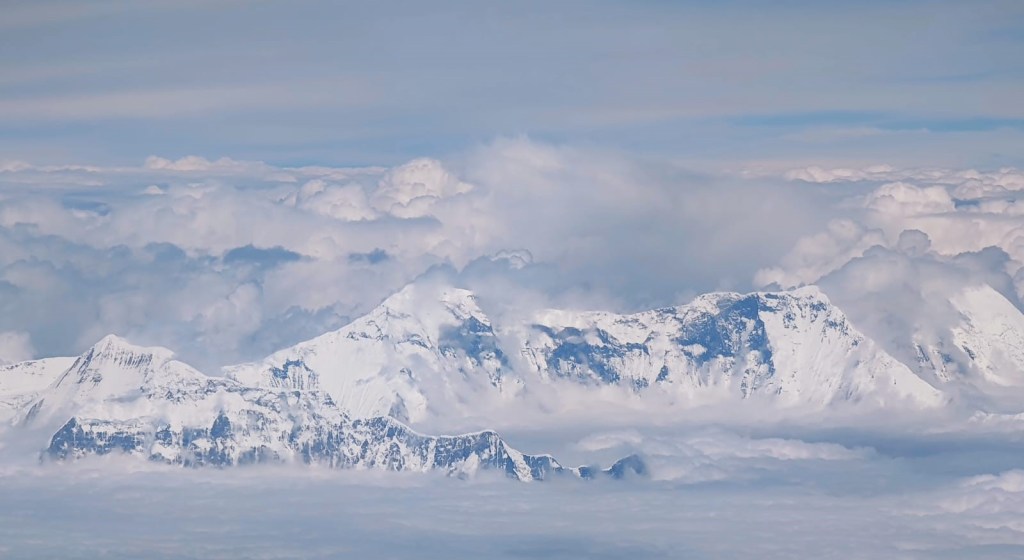
Unfortunately, I’m not able to find the picture of my view from my room but here’s another shot from the flight. It was pretty much this view for all 8 days!
If Nepal was the spark that started my reconstruction journey, my return to Chennai became the slow, steady flame that strengthened it. It was a space that rightfully took the baton and challenged and healed me in ways I hadn’t expected. That’s the story for Part 7.
 The Theologian's Daughter
Leave a comment