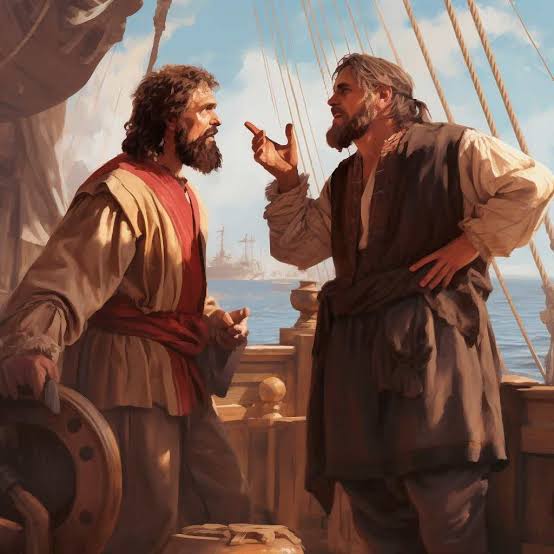
What ancient disagreements can teach us about worship, unity, and spiritual nourishment (Acts 15:36-41)
Two thousand years ago, Paul and Barnabas had a sharp disagreement — one so serious that they parted ways. Yet instead of halting the mission, their separation multiplied it. Could it be that sometimes, God uses our differences — even our disagreements — to further His own mission?
I think so. It’s clear that God can and does work through our diversity. After all, we were created with different personalities, inclinations, and callings.
This brings to mind another historic disagreement.
- Martin Luther and Ulrich Zwingli
Back in the 16th century, two of our beloved early reformers Luther and Ulrich were trying to decide on what practices should be retained from the Roman Catholic Church as they helped shape what would become Protestantism. Their own views were the following:
Luther’s view: “What Scripture does not forbid, it permits.”
Luther believed that if the Scriptures didn’t prohibit a practice, it could be retained — a perspective that led to traditions that kept liturgy, vestments, and structure. This became the foundation for what we now call High Church Protestantism: Lutherans, Episcopalians, Anglicans, and others.
Zwingli’s view: “What Scripture does not command, it forbids.”
Zwingli, on the other hand, felt that if the Scriptures didn’t command a practice, it must be removed. His more minimalist approach laid the foundation for modern day Low Church Protestantism: Baptists, Independent, Pentecostal, Quaker and others.
2. High Church and Low Church: A Quick Guide
(You may skip this section if you are already familiar!)
While all Christians — Catholic, Orthodox, and Protestant — broadly agree on non-negotiables like the Trinity, the Atonement, Baptism, and Communion, Protestant churches also share further common ground among themselves. These include beliefs such as Jesus being the direct mediator between God and humanity, salvation through grace alone, the removal of icons, and the rejection of priestly confession as a requirement.
Unlike the Catholic–Protestant divide, which was primarily theological — especially concerning authority, sacraments, and salvation — the classification of High Church and Low Church within Protestantism is more about worship expression, structure, and culture than core beliefs. While the theology across Protestant denominations often aligns, the methodology and style of worship can make High and Low Church traditions feel worlds apart.
In a High Church (also called as Anglo-Catholic) context, one is most likely to find:
- A defined altar and pulpit
- Clergy in traditional vestments
- The structured use of the Nicene Creed and other liturgical elements
While High Church Protestants do not believe that the church building or the clergy are inherently “holy” in the Roman Catholic sense, they place symbolic and reverent value on what these elements represent. High Church traditions often retain more continuity with historic Christian worship practices, appreciating their roots in Roman Catholic liturgywhile maintaining distinct Protestant theology.
In a Low Church (also called Evangelical-Centric) context, you are more likely to find:
- A minimal or flexible space to worship
- A more informal worship style with spontaneous prayer and contemporary music
- Longer sermons, expository preaching, and emphasis on Bible study
After all, Low Church practices emerged in part from a desire to reform not just theology but also practice — stripping away what they saw as unnecessary ritual in favor of simplicity and accessibility. Their aim was often to recapture the spirit of the Early Church, where worship was centered around Scripture, fellowship, and shared prayer, without the hierarchy or ceremony that developed later.
Both approaches can be meaningful, reverent, and faithful. And I’ve seen the value of both up close.
3. Worship Approaches as Tools
I often see worship styles the way I see cutlery. One person may prefer a fork and knife, another a spoon, another a pair of chopsticks, and another their fingers. This is widely shaped by geography, upbringing and personal preference and each person takes what’s best for them. But at the end of the day, the question isn’t how they’re eating. It’s WHAT they are eating.
Often, as we argue on the methodology of worship I think of it as fighting against which cutlery is important. When the question we should all be asking is if the food we are eating is nourishing our bodies and souls.
In the same way, whether our worship is structured or spontaneous, what matters is: Are we in a space that allows us to know God and ourselves in a wholistic way?
As someone who grew up attending the Mar Thoma Church — which reflects a High Church, Eastern Protestant tradition — while also being raised in an Evangelical Protestant home, I’ve often found myself standing in between. I love the incense, hymns, and rhythms of the Mar Thoma order of worship which taught me reverence and rootedness. But I also find myself blending in the evangelical spaces because I love the simplicity and accessibility of the worship. It gives me the idea that even reaching out to God should be as simple as this. Both spaces have taught me intimacy and a personal responsibility to thirst for God. And I find this as a way for me to understand a fuller picture of who Jesus is.
One side reminds me of the Lordship of Jesus. The other, reminds me of the Friendship of Jesus. And I think this has given me the privilege to have a broader and fuller experience in my personal walk with the Lord.
Maybe you resonate with that. Or maybe you thrive in one space more than the other — and that’s okay. There is room for both in the Body.
Conclusion – Room for both in the Body
Disagreement doesn’t always lead to division. Sometimes, it leads to multiplication, depth, and diverse expression — just like it did for Paul and Barnabas.
Can you think of a time when a disagreement in your life led to unexpected fruit? Something new, meaningful, and God-honoring?
God is not afraid of our differences. He often works through them — and so can we.
Interesting points to note:
Hi there! Here are a couple of points I would like to acknowledge as I pieced this writing together.
Theological Roots:
1. Luther and Zwingli mainly had a theological disagreement on the Eucharist. While Luther acknowledged that Christ is Present in the Eucharist (Consubstantiation) Zwingli thought of it as a remembrance of Jesus death (Memorial).
2. Modern day low church has only come about in the 1800s. However, the school of thought and it’s ideas were present as early as the conversations of our Protestant Fathers.
3. Many modern churches today identify as Broad Church — blending both structured and informal elements.
Eastern Church Parallel
4. This was one of my favourite discoveries while writing this. I realized that within Indian church history, a similar narrative exists.
The Mar Thoma Church broke away from the Malankara Orthodox Church over theological reform, much like Protestantism from Catholicism. However, the St. Thomas Evangelical Church of India (STECI) separated from Mar Thoma over ritual and liturgical vestments — not doctrine.
While the in the west we have
Roman Catholicism → High Church Protestantism (Anglican) → Low Church (Pentecoastal)
the East has
Oriental Orthodox → Oriental Protestant (Marthoma) → Evangelical Protestant (STECI).
Pretty neat, huh? 🙂
Author’s Note:
While I personally find myself theologically more inclined with evangelical spaces— especially in their emphasis on accessibility and simplicity in worship — I’ve grown to deeply appreciate the beauty, symbolism, and reverence found in the church liturgy. High Church and Low Church in no way mean that one is superior to the other. They are simply different ways of expressing the same faith — very much like cutlery. Different tools, same nourishment. My goal in writing this is not to promote one over the other, but to explore how both expressions can uniquely nourish the Body of Christ and reflect the fullness of our faith heritage.
May God bless us all as we pursue to know Him better through whatever means suits us best.
 The Theologian's Daughter
Leave a comment