
Greetings to you all in the name of our Lord and Savior, Jesus Christ. I consider this an opportunity to speak to you all from the Word this morning.
For our meditation today, let us turn our Bibles to Isaiah 1:17.
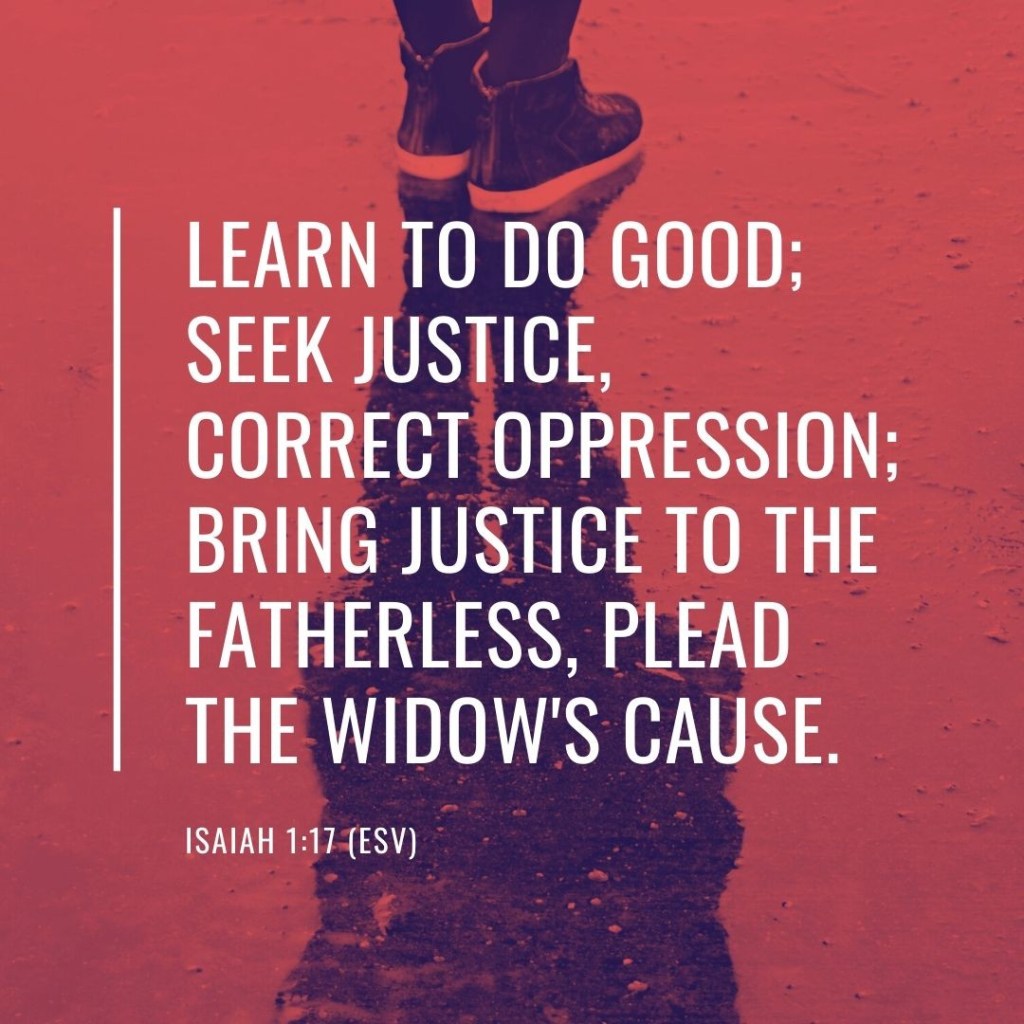
Let’s Pray: Dear Lord Jesus, I submit myself into your hands. May the words I speak, proclaim life and may the words from my mouth speak to your people. In Jesus name I pray, Amen.
The Holiness and Sanctity of God
We come every Sunday to worship God. One of the very prominent portions of our liturgy is, “Holy art thou, Oh God”, “Holy art thou Almighty Lord”, “Holy art thou, Immortal Lord”, “Oh Thou that was crucified for us, have mercy on us”. Even as the choir we sing that the Lord is Holy, he is Immortal and he is Almighty. So when we say that God is Holy, what do we mean? Holiness not only implies the purity and sanctity aspects but also the righteousness if God. He is an upright, virteous and righteous God. And when we say that he is a righteous God, we also mean that he is a just God. Holiness and justice go side-by-side with each other. One cannot do without the other.
What is Justice?
So, what is justice? Usually, the desire for justice is something that triggers within you when you feel violated. So when do you feel violated, you may ask?
- Well, suppose, you open the newspaper and see the headlines that a girl has been raped/murdered, you may feel a sense of injustice for the girl and her family.
- Or when your boss calls you to work during the weekend, you may feel violated that he isn’t respecting your personal time.
- Or, it could be something as simple as, you may also feel violated when – suppose you’re standing in a queue and someone barges in and breaks the queue.
So these are all different levels of violation but in some way or the other they may trigger something within you which says, “No, I don’t like the way this situation works. I wish something could be done to change it.” And that is where the seeking of justice comes into play.
Scriptural Examples of Justice
I personally believe that everyone of us in some form or the other, deeply yearn for amendment and correction for justice to prevail. And the Scripture is also full of examples of justice.
- We have the example of King Solomon handling injustice when two mothers were fighting over the same baby.
- In the book of Acts, we see the early church handle the injustice done to the Greek widows when they were overlooked during the food distribution.
- And we also have the famous story of the Good Samaritan, where a Samaritan passes by a wounded Jew and sees that he’s been beaten and robbed and sympathises with the injustice done to him and does whatever he can to help this man recover.
So, this is a recurring theme in the Biblical narrative. It’s not new to any of us. And so I hope even today’s message is a reminder of what we as Christians or what we as image bearers ought to do.
Shiprah and Puah – The Midwives

So, for today’s message, let us look at a passage in the Old Testament where we see two women dealing with the dilemma of justice in their work lives. Can somebody read Exodus 1:15-21?
15 The king of Egypt said to the Hebrew midwives, whose names were Shiphrah and Puah, 16 “When you are helping the Hebrew women during childbirth on the delivery stool, if you see that the baby is a boy, kill him; but if it is a girl, let her live.” 17 The midwives, however, feared God and did not do what the king of Egypt had told them to do; they let the boys live. 18 Then the king of Egypt summoned the midwives and asked them, “Why have you done this? Why have you let the boys live?”
19 The midwives answered Pharaoh, “Hebrew women are not like Egyptian women; they are vigorous and give birth before the midwives arrive.”
20 So God was kind to the midwives and the people increased and became even more numerous. 21 And because the midwives feared God, he gave them families of their own.
Okay, so in this passage we read about the Hebrew midwives, Shiphrah and Puah. Exodus 1:1 onwards, we see that the sons of Jacob went along with their brother, Joseph, to Egypt and settled there and the Lord blessed them, and they were fruitful. And so, after several years, when the new king came -who didn’t know anything about Joseph and the way he administered to Egypt and helped handle the famine and drought in Egypt – he saw that they were fruitful and multiplying in number and this alarmed him.
He thought that there had to be something where he could control the population of the Israelites. So, he goes to the Hebrew midwives and commands them, that when a Hebrew woman gives birth to a female child, let her live, but if it’s a male child, do not let him live.
In regard to the passage we just read, there are three points that I would like to draw your attention to.
1. They were known for their commitment to their profession
The King knew that the Israelite women relied on Shiphrah and Puah for their delivery needs. Their dedication and commitment to their work was so strong that the king thought that by telling these two women alone, the male population, which will be the strength of the nation, will be under control.
So Shiphrah and Puah were excellent in their profession and also had high levels of professional ethics. Speaking of ethics, let me come to my 2nd point.
2. They knew that just because something is legal, it isn’t necessarily ethical
The King had not only allowed them to kill newborn males but commanded them to do so without fail. But it did not sit well with their values, it did not sit well with their principles. They had the discernment in them. They knew that just because the King tells them to do something, it doesn’t automatically make it right. And they used their discernment and let those boys live.
3. They were bold enough to disobey Pharoah
According to the Egyptian rules, disobedience to the orders of a King can lead to imprisonment and/or death without any trial. Now sometimes, the punishment can be extended even to the family members.
Now we read in the scriptures that when the Pharoah questioned them, they said that Hebrew women give birth even before the midwives come, which wasn’t true. If they were caught, by chance, they knew that they would probably lose their lives as well.
But something to be underlined is that, they feared the Lord more than they feared the Pharoah.
What is Holiness?
So, coming back to my question, what is Holiness? Or what is righteousness? It is using your God-given discernment and doing those acts of justice in our profession and in our everyday routine. Let us search the Scriptures to find out verses that talk about justice.
Can somebody read Micah 6:8 for me?
He has shown you, O mortal, what is good.
And what does the Lord require of you?
To act justly and to love mercy
and to walk humbly[a] with your God.
Can someone also read Jeremiah 22:16 for me?
He defended the cause of the poor and needy, and so all went well. Is that not what it means to know me?” declares the LORD.
Is this not what it means to know the Lord? Today when the choir sang, ‘Father, I adore you, I lay my life before you. How I love you.’, the Scripture says that, our expression of love, adoration and worship becomes fulfilled in our acts of justice when somebody under our care is seeking for it. And this is what it means to know God. This is what he Lord requires of us.
So, when we proclaim that the Lord is Holy, when we say that he is righteous we also mean that he is a God of justice. And as image bearers/ imitators of Christ it is our duty as well. Justice isn’t just an act of convenience, but a duty or a burden that we all must take upon in whatever area God has placed us in.
Examples from history: The Quakers & Father Tutu

Before I wind up let me also mention about The Quakers. This is not something that we have learnt in our history text books but a lot of aspects about this particular group has fascinated me. So, the quakers were a group of British men and women, all white all Caucasian, who were against the practice of slavery. So, they were a group of Christian Britishers who were actively part of the anti-slavery movement happening in the 17th and 18th century. And mind you, this is in a time when the Bible was used to justify and propagate slavery.
This was in a time when if you walked into a church the pastor would preach saying ‘Hey! Abraham and many of our patriarchs had slaves. Paul even tells slaves to submit to their masters in Ephesians. So it must be okay to have slaves. It must be in God’s will to own another human being. And who knows, maybe through us God may redeem them.’ This was the normal outlook and narrative being spread during that time.
But the Quakers, were convinced that slavery cannot be Biblical!
They had the discernment to know that Christ-likeness cannot be compatible with owning and exploiting another human being. And so they didn’t let their privilege of being a certain color or a certain race affect what they knew to be right.
There is also the example of Father Desmond Tutu. For those of you who don’t know, Father Tutu was an archbishop of the Anglican church of South Africa, passed away very recently in December 2021 and he is known for his opposition to the apartheid that happened in South Africa. So he stated this and I quote:
“If you are neutral in situations of injustice, you have chosen the side of the oppressor. If an elephant has its foot on the tail of a mouse and you say that you are neutral, the mouse will not appreciate your neutrality.”
Prayer for Social Justice in our Daily Calling
I pray that we all have that kind of discernment in our own walks of life. Today as the choir sang, “Holy Spirit, living breath of God, breathe new life into me”, I pray that the Holy Spirit breathes life into all of us and anoints each one of us to be just, in whatever profession we may be in. As children of God, we are called to exercise this attribute of God and extend justice to those in need.
Our country is also going through a similar kind of turmoil like the one mentioned in Exodus. Our present ruling party has been stirring up fear, has been stirring up division and, I don’t know, but it is probable that in a few years it would not be legal to practice Christianity publicly.
So this is my prayer, that just like Shiphrah and Puah, who were mere midwives and did not have any influence on the King, we as well, in our professions do what is right in the eyes of the Lord.
We are called to perform our little acts of justice in our homes, in our neighborhood and in our professional contexts. I pray that when we say, “God, you are Holy; Oh God, you are righteous”, we remind ourselves that we as children of God need to have the same essence of being righteous- of being just.
And I pray that wherever God leads us and guides us, we always persevere to be righteous in His eyes and in all walks of life. May God bless us all.
Note to the Reader:
On the 22nd of May 2022, I had the priviledge of preaching in the Secunderabad – Hyderabad Mar Thoma Church, formerly known as the St. Andrews Marthoma Church, the very church that I grew up in. The date is important to me because this was around the time that I was re-discovering my faith and finding my calling and purpose alongside understanding Jesus. This was a time when I was struggling to articulate my thoughts on my faith.
But it gives me immense joy that the Lord can use us in phases of our lives where we don’t expect to be of any use. And through this I was able to organise my thoughts on the Calling of Social Justice that people of God are called to. Preparing for a sermon indeed changes you. It transforms you even before it reaches the ears of the audience listening.
Today, almost two years later, I am still reminded of this day and how I let it influence major aspects of my life.
Special thanks to Rev. Saju Chacko Achen for entrusting me with this, my parents who guided me through and of course, my dear church elders, Sunday school teachers, choir members, youth league, Sunday school children and everyone in the congregation for listening.
 The Theologian's Daughter
Leave a comment